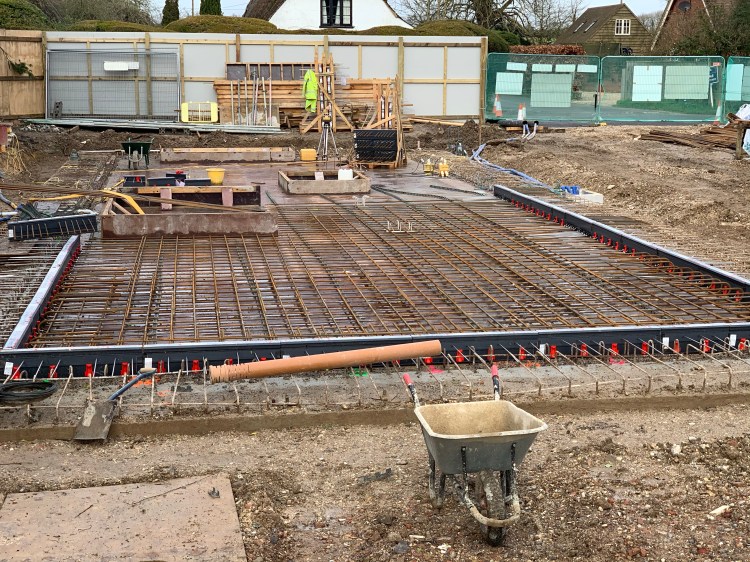
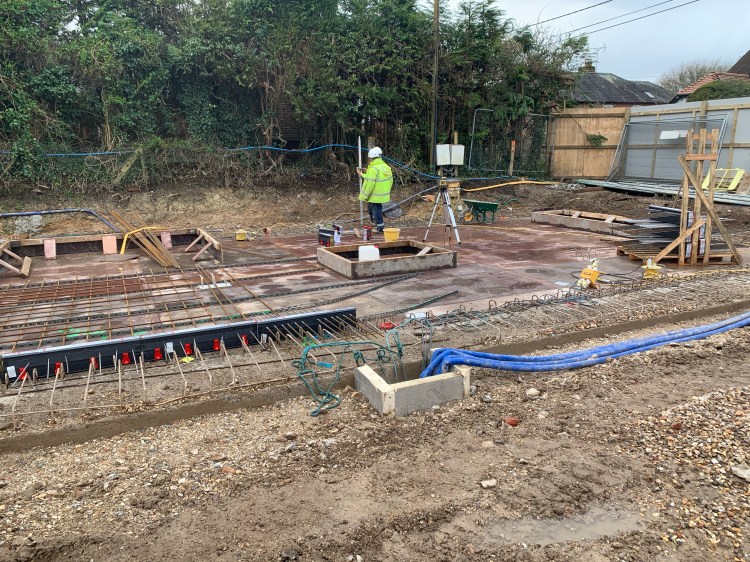
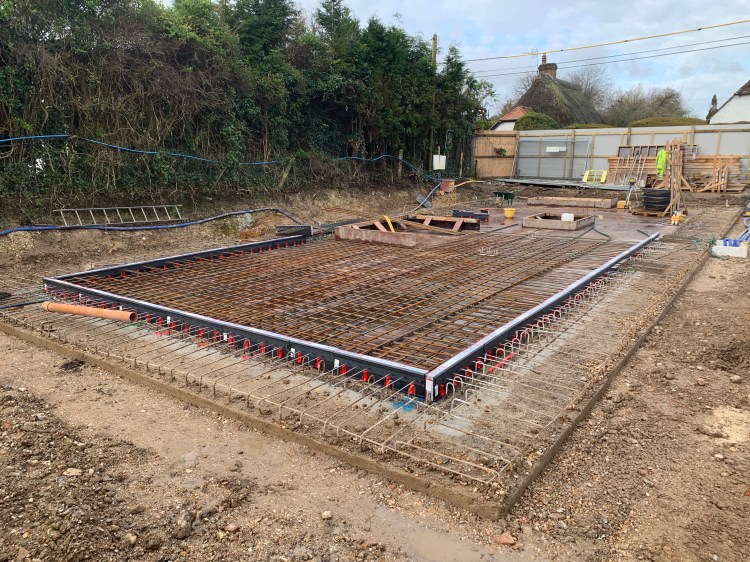
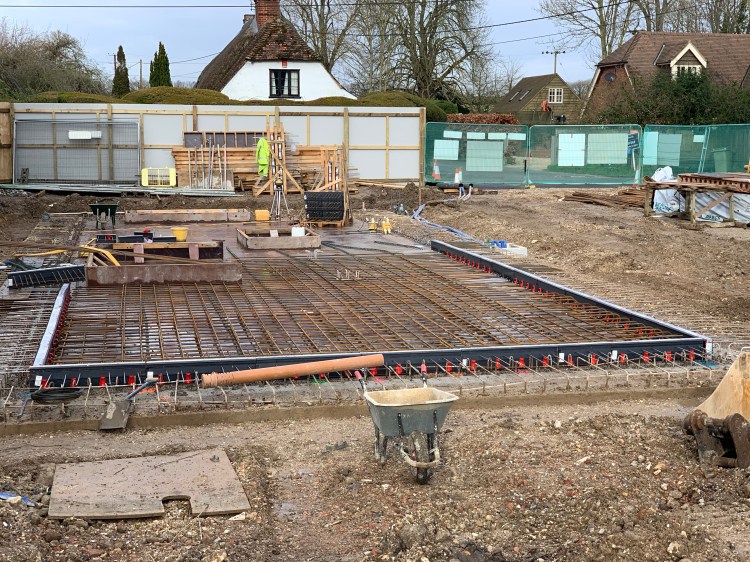
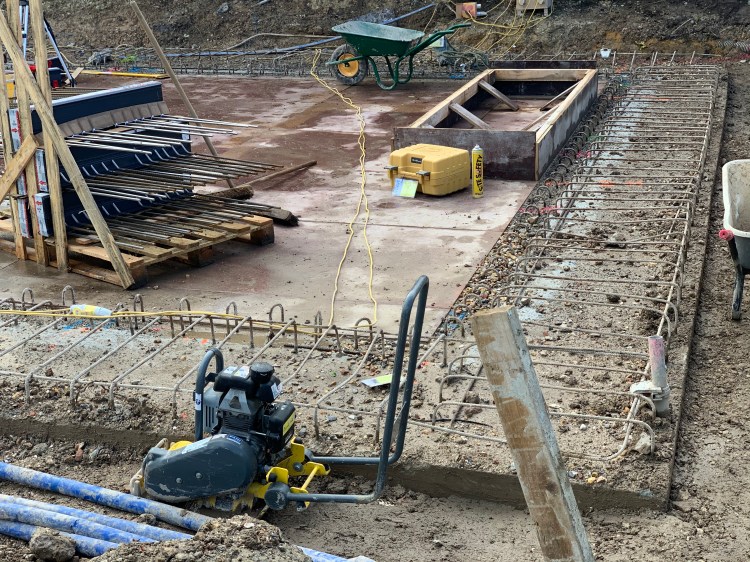
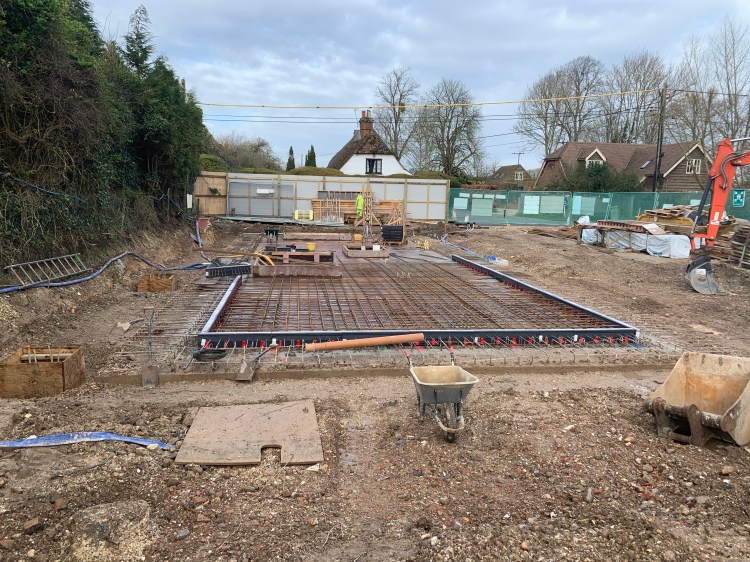
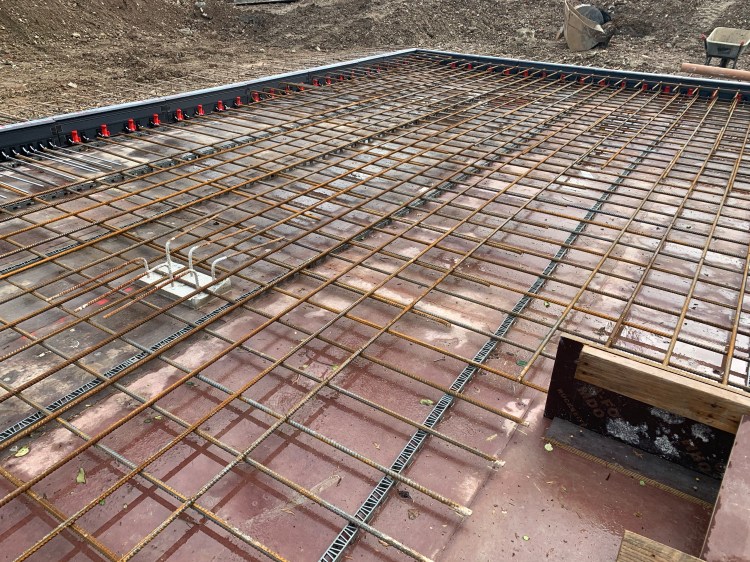
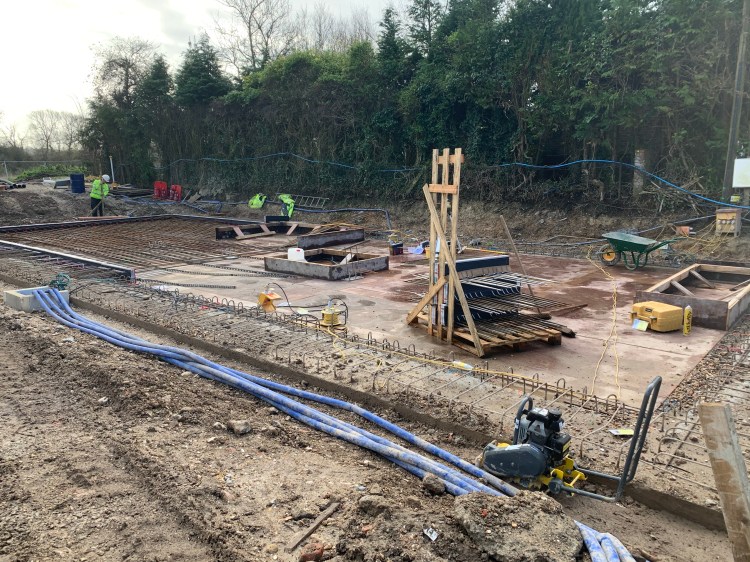
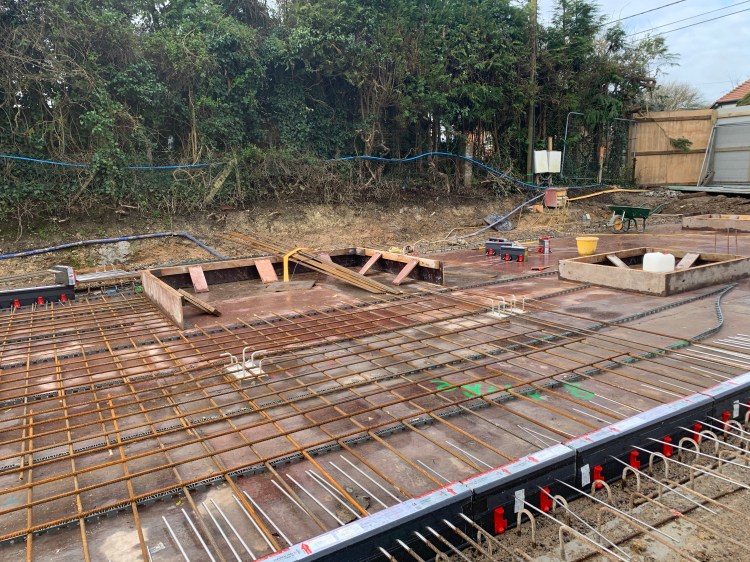
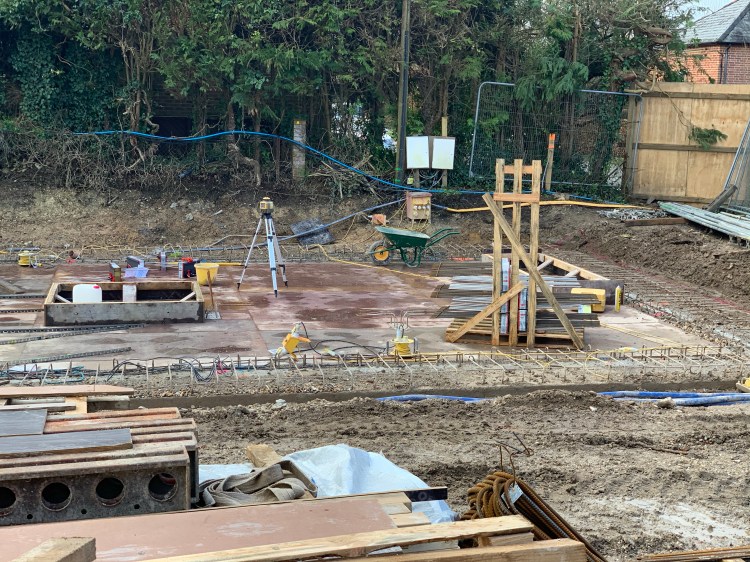
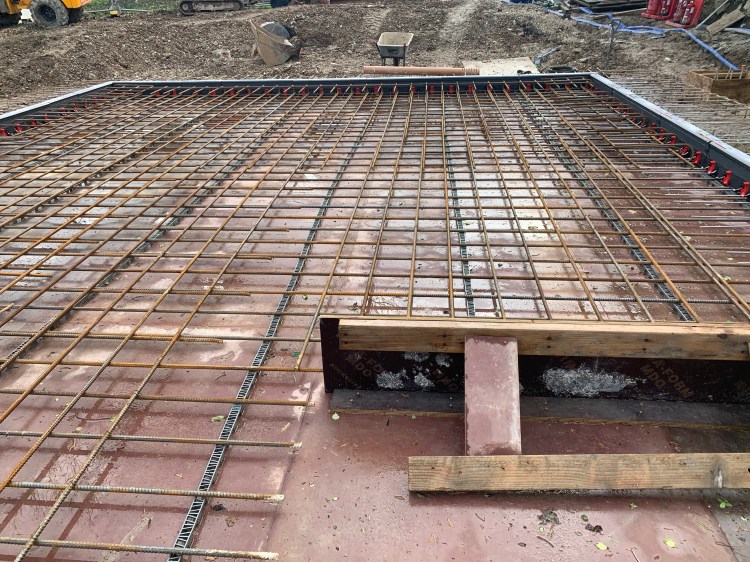
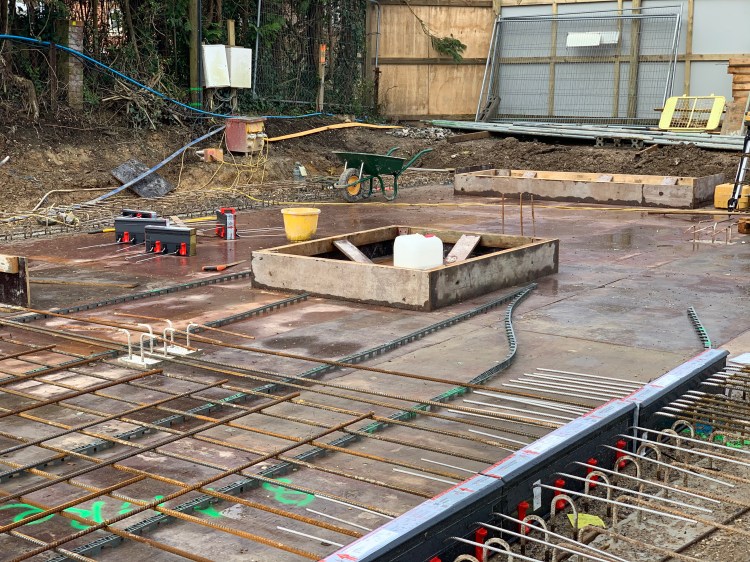
The groundwork team were busy covering the basement with, planks, formwork, shutters, steel rebars and thermal breaks to enable pouring the concrete to form the ground floor (basement cover).
They had to work super fast last week as we had to literally baton down the hatch as Storm Ciara was fast approaching over the last weekend.
Needless to say, they managed to finish the formwork, cutout positions for the future lift, roof-light and the staircase. If you look closely at the pictures below, you will see the smaller hole in the formwork is the one for the lift. We’re not putting in any lift for the foreseeable future. We’re just future-proofing the design of the house.
The bigger square hole is the position the helical stairs will go into. The rectangular hole in front is the roof light into David’s bedroom in the basement. The black plastic that’s on the boundary are the thermal breaks. These support the edge of the slab to reduce heat loss. Since we’re building an air tight house, we need to be mindful of this. Uninsulated slab edges penetrating insulated building envelopes act like heat sinks, creating a thermal bridge between the cold exterior slab edge and the warm interior floor slab, exposing the building to short- and long-term problems.





On a final note, when the storm did land in Houghton, we had a power cut which meant the dewatering pumps that empty into the main drain stopped working. When Pete checked yesterday, the basement only had about 100mill of water basically from the open holes. Amazing!
We’re incredibly overwhelmed by the response of some of our neighbours who reached out to Pete our Colmar Site Manager on Sunday to let him know we have a power cut and also checked to see the pumps go back on when the power was restored. Really appreciate them. It’s also a testament to the effort that Pete has put in to build a relationship with our neighbours.
It’s not easy building in a village with all the noise and traffic. Pete and I were monitoring the storm using the security cameras we have placed all over the site from the app on our phone. When we had the power cut, we lost the connection to the app. However, I’m on the village email list the constant update from neighbours saved me the 10mins drive to site to check what’s going on given the high wind and falling trees, it was not a good idea to drive.
Having everyone on side is not easy. Pete deserves a lot of credit for the proactive way he’s built up a relationship with our neighbours. Thanks Pete!
French Drains
The benefit of building the basement when the ground water is high and the incessant rain we’ve had is you get a good idea of what works and what doesn’t for managing ground water in an area like ours.
Anyhow, our main contractor suggested we put in a French Drain to effectively let the ground water weep into the ground and main drain, away from the property. I’ve snagged the below from here.
As you may have guessed, a French drain is a type of drainage system. The primary purpose for most French drains is to manage surface water and groundwater. With most French drains, the idea is to take water that could threaten a structure, and move it to a place where it is no longer a threat.
You may have seen a French drain before. It looks like a trench that has been filled with gravel. Under that gravel, there is likely to be perforated drainage line, and if you were to go to the discharge end of the French drain, you would see the end of the perforated pipe.
You’ll often find the terms “French drain” and “weeping tile” used interchangeably. While this is usually acceptable, there are some slight differences between the two. A French drain is typically installed just below the surface, and its main intent is to prevent the over-saturation of soil. A weeping tile is a type of French drain, and it is a drain that is built to protect a structure against hydrostatic pressure. Since they are often used to protect the foundation of a structure, the pipe is usually much deeper in the ground.
If you are using the terms interchangeably or hear someone else do, it is no big deal. It has generally become accepted that they both refer to the same type of drainage system, and people will know what you are talking about either way.
How does a French drain work?
Whether you are talking about a French drain or a weeping tile system, the drain will work under the same principles. Gravity will always cause water to flow downhill, and the flow of water is always going to follow the path of least resistance. The operation of a French drain relies on these facts of nature to manage the moisture in soil.
As I mentioned before, a French drain is made from a piece of perforated pipe that is laid in a trench and surrounded by gravel. The gravel or stone in a French drain serves multiple purposes, but the most important feature of this packed gravel is that it is more permeable than the soil on the surrounding land. In technical terms, the gravel or stone in the drain would be known as the envelope. The increased permeability of the envelope allows water to flow more easily, and this draws the moisture from the surrounding soil, making the trench the path of least resistance.
A French drain is buried underground, collecting ground water
French drains have been around for quite some time, but a modern French drain is also likely to have some type of landscaping fabric covering the gravel. The purpose of this fabric is to prevent the growth of weeds and to reduce the amount of sediment that can run down into the trench, and potentially clog the French drain.
Different types of pipe might also be used in the construction of a French drain. Some might use PVC that comes with holes predrilled, and in others, it is common to use a flexible drainpipe with small slits in the side. The choice between the two can depend on the exact application, but PVC tends to be more durable. You can also find pipe that is encased in a type of landscaping fabric.
A French drain will also be graded with a slope that descends away from the area from which you want to remove the moisture. This slope is where gravity comes in. The sloping grade of the trench, and therefore the pipe, will cause the water to run downhill to a discharge point. So you have the gravel that makes the trench the path of least resistance for the water, and you have the grade to take advantage of gravity, and make the water flow in the intended direction.
The discharge point of a French drain will depend on the application for which it is being used. You obviously want to direct the water to a location that is away from whatever you are trying to protect from groundwater, but there could be various laws and building codes that may prevent you from placing the discharge in certain locations.
In our case, it’s towards the sustainable urban drainage system we’re putting into the meadow and into the main drain in the village. We’ll also have a fail safe system with a couple of sump pumps that gets triggered by a float if the water reaches a critical level.
This Week and Next Week
The team will finish the formwork for transferring the slab this week weather allowing. The plan is to pour the concrete next week Monday. Fingers crossed for good weather!
 Dianthus