I can’t do justice in this post detailing the moodboard, inspiration and ideas that underpins why we’ve gone for the final design for Dianthus.
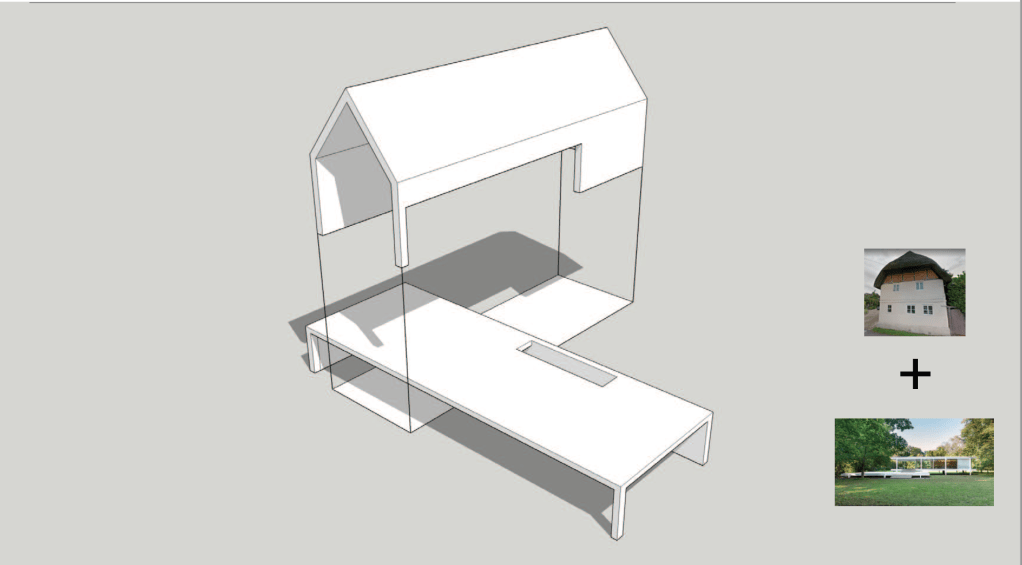
Needless to say, we had several things to consider before we ended up with the barn structure cantilevered on top of a bungalow design.
Working with Rob Jackson of 527 Architects on this has been such a pleasure. He intuitively interpreted our garbled thinking time after time into something that translates into a coherent design. Secondly, we want Rob to win an award for this so we’ve indulged each other. Not sure if we needed encouraging on that given some of the eclectic things we have in mind.
In terms of constraints, they include, site, compliance with village design statements, ridge height relative to neighbouring properties as well as what the parish council and the planners will entertain.
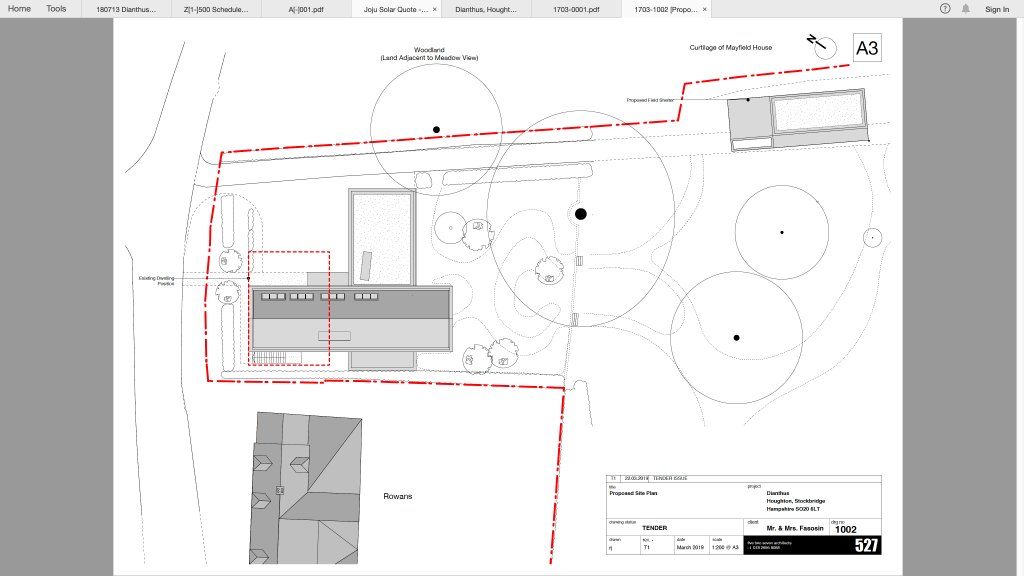
A reminder that the Dianthus site is a 1.3 acre piece of land. However, 0.3 acres of that is the front of the property as indicated below is narrow, close to the road and also has a small garden in the rear with the big ash tree acting as a natural boundary or transition to the conservation meadow at the rear. This is the remaining 1 acre that needs to be maintained as a conservation meadow vs. a garden. There is a gate at the south eastern end of the meadow that leads to the River Test. Albeit, the field adjacent to the river is owned by our neighbour. Great spot for watching trouts swim past on their way to feed in Stockbridge by tourists or caught by members of the local fishing clubs. Oh, the fishing clubs are private and they cost a bomb to join. The Test is one of the best rivers in the world to fish in given chalky rivers tend to be clean, clear and are good at filtering stuff.
Concept
So, once we’d established the size constraints at the front and the ridge height vs. the neighbouring property Rowan. The design choices available to our architect was to design a traditional two storey pitched dwelling facing and perpendicular to the road with a single storey ‘pavilion’ at 90 degrees to this. Thereby maximising views to the adjacent meadow and not overlooking neighbouring dwelling.
The Proposal
As you can see from the above plan, we’d established that the dwelling will be enclosed on two sides by a front courtyard area for vehicles to park and turn. The planners also impose design constraints on visibility splay and turning of cars into the road. Conceptually, we always wanted a grand entrance and hall that leads to a feature staircase connecting the basement and the first floor. There were some clever design inspirations that Rob included working with our lighting designers Michael Grubb Studio. They include, a helical feature staircase, feature lighting that drops from the ceiling on the first floor to give volume to the entrance hallway.

We intend to have our family photos gallery next to a feature flint wall on the inside as well as accessible entry all around the ground floor for wheel chair access to the disabled bedroom and ensuite wet room for our son Lase also on the ground floor.
We’d stated that the downstairs should be focussed on the rear of the house giving maximum views of the meadow. Rob designed the main space as an open plan kitchen/dining sitting space which opens up to the rear garden through large sliding doors providing uninterrupted views to the meadow.
We also asked that we have round edges as much as possible. Needless to say when we saw the cost at estimation time of round edges around the house we scratched most of it as it was super expensive. Round costs money. We’ve still retained it where we can. I’ll cover that later.
External Cladding, Facade and Design Statement
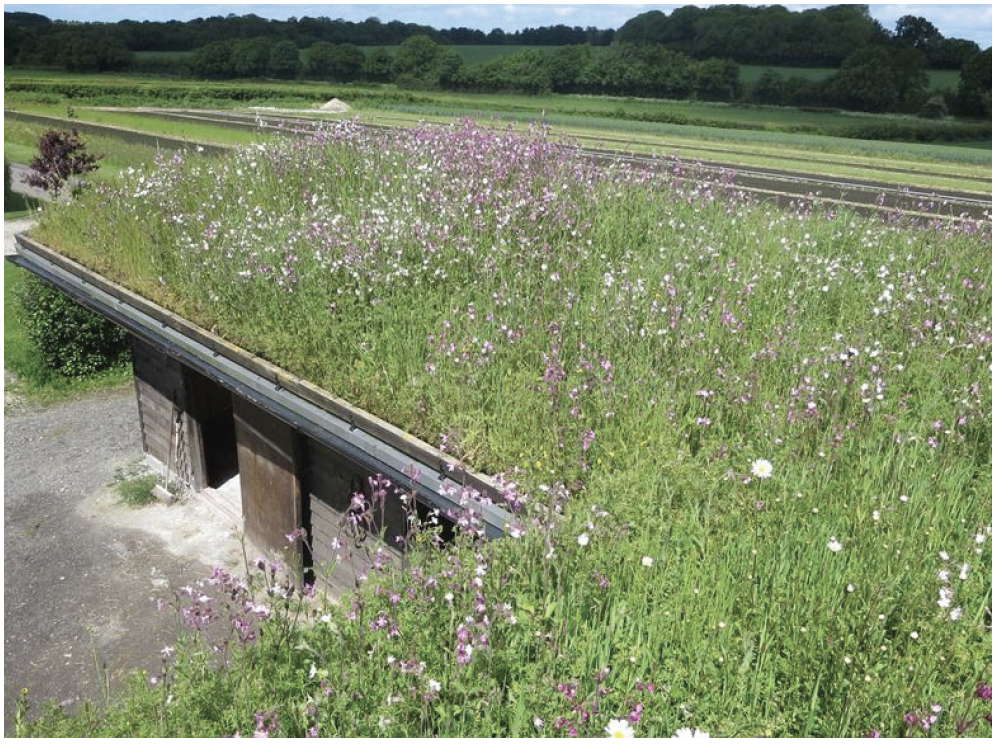
The external walls will be a combination of flint faced concrete blocks locally sourced from I Block and British oak timber cladding arranged in both horizontal and vertical orientations. A ‘framework’ of steel trims edges, bases and gable ends and supports masonry over openings. The pitched roof is welsh slate and GB Sol Photo Voltaic Slate array which combined with the welsh slates discreetly blends the solar tiles into the roof. We wanted to use Tesla Solar Roofs honestly, we gave up waiting for them. The flat roof is a wildflower green roof on a warm deck. Some context on the wildflower green roof. The entrance to our paddock is literarily facing the views as you’re walking to or back from Broughton down the Clarendon Way on Faithfulls Drove, which is a local walk in Hampshire. See the image below.
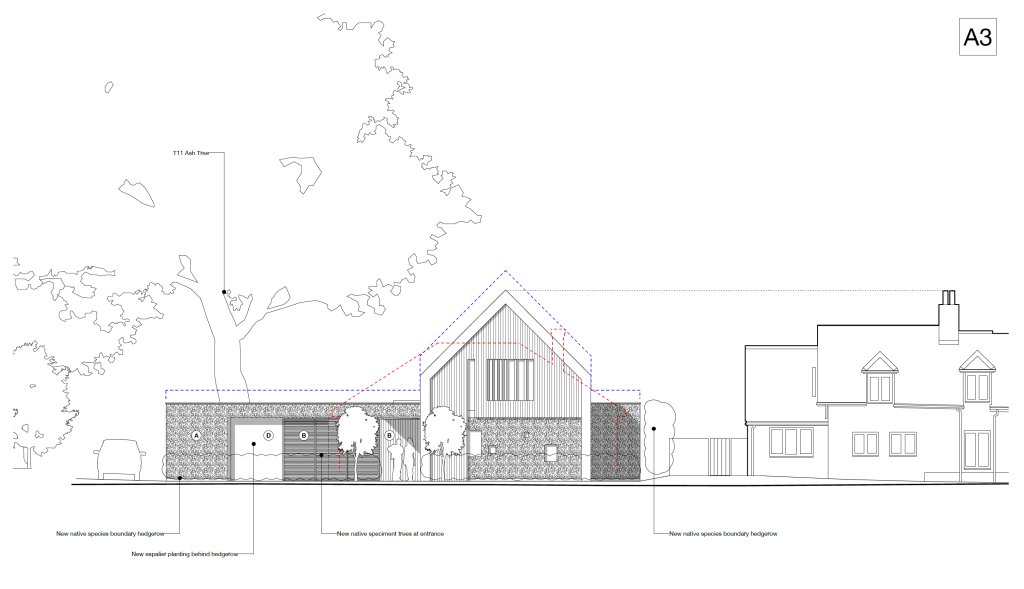
So, we thought we’d give the effect that you’re looking straight down the meadow without the house getting in the way by having a wildflower meadow on the flat roof so you have the illusion of looking straight beyond the house towards the conservation meadow in the rear.
Here is another image below from the wooden model Rob Jackson created.
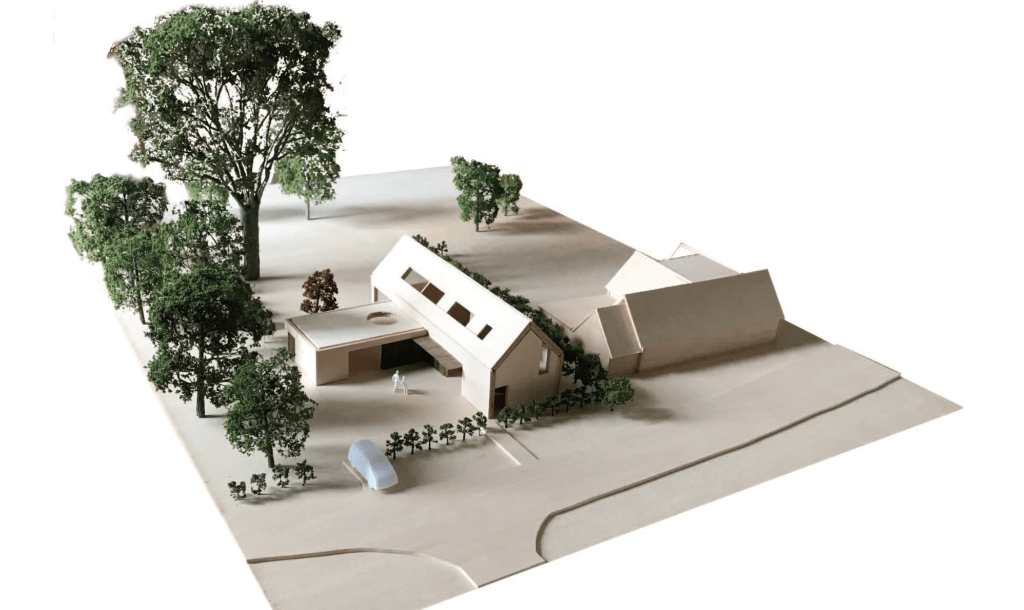
Here is an example below of what we hope the roof will look like eventually.
North Facing Gabled End Treatment
Conceptually, we initially toyed with the idea of stained glass windows at the gabled North end of the house facing Faithfulls Drove. So, we’d give the impression Dianthus is the village chapel using the local flint and stained glass windows on the Gabled End.
The reason is we’re on the main drag in the village and the village church is not on the main drag. What’s surprising as well is that very few of the houses on the main drag use flint which is the local stone for cladding. So we were dead keen to achieve the village design statement but set a high bar for ourselves in terms of how the flint is rendered vs. pastiche. Ultimately, you end up with a timeless barn structure even though it’s a contemporary build.
Some thoughts that guided our final decision on the gabled end. We didn’t want to overlook any of the neighbours opposite. In fact, when we consulted with them, they were pleased we didn’t intend to overlook them with see through windows. One brilliant idea Rob came up with for the final design, was that we go with Asymmetric recessed windows. A key consideration was how to treat the windows in Lase’s room on the ground floor. Given his disability, we thought the colourful stained glass window will make his bedroom and ensuite wet-room a sensory space with different colours reflecting into the room at different times of the date.
Here is the initial moodboard concept we started with and the final design we ended up with below it. Our daughter, Ariadne’s room on the first floor also has asymmetric stained glass windows. Lase’s room at the bottom has staggered recessed stained glass windows. Also asymmetric. We were very pleased with the final design.


Structure
As already covered in a previous post on Structural Engineering, The basement is a concrete ‘box’. This is designed as an in-situ piled solution with waterproof concrete liner and waterproof membrane. The superstructure is a steel frame with SIPs panel infill and engineered joist floors. The roof is made from SIP as well between the steel frame. Dianthus and indeed, the local village is not on a mains sewer. Therefore, we need to provide a packaged treatment plant included as part of the design. One of the privileges of living in a village. I hasten to add tongue in cheek.
Building Services
Our aspiration as covered in a previous post on Building Engineering is for a highly sustainable building. This demands very good levels of thermal insulation and very high levels of air-tightness.
The energy efficiency aspirations for the house are high (net Energy Positive over a one year period – i.e. more energy in kWh is generated than is used), and the quality of finish both in terms of appearance and function of all elements of the services installations must be exemplary.
A highly efficient building fabric (insulation, air-tightness) means the loads of the building are reduced. The majority of the loads are served from a heat pump installation to be delivered as part of a turnkey solution from a single specialist, which will provide heating (or cooling) to an underfloor system and heating to a hot water calorifier. The heat pump will draw energy from a borehole ground array.
The ventilation is via an MVHR system with ductwork to all rooms for background ventilation. Electrical power will be provided via. a PV array on the roof to battery storage supplemented by an incoming mains supply. Electrical vehicle charging is an important requirement and will be provided by Connected Kerb, a London based Start-up that I sit on their Advisory Board. I will cover which of the products and the special considerations we gave to this in a separate post.
In terms of energy efficiency, we’re aiming to comply as much as possible with the Passivhaus standard. We don’t know if we’ll be certified. However, we’re aiming for the below in terms of energy efficiency and space.
Gross Internal Area: 385sqm across three floors (basement, ground and first),
U-values: 0.1W/m2K for all walls, roof and floor and 0.8W/m2K for glazing,
Air-tightness: 2m3/m2.h @50pa pressure.
Landscape
The garden space is to be regraded to create a ‘ha-ha’ to the meadow whilst not affecting the existing trees. The existing above ground HV powerlines in the meadow will be buried by the SSE so we can move the existing field shelter below it’s current location away from the tree protection area of the ash tree in the garden. More importantly, remove the eyesore of cables as far away from the main meadow as much as possible. I’ve covered Landscape Architecture considerations in a separate post in detail.
Closing Thoughts on This Section
I will start going through each room and the inspiration behind the design choices in subsequent posts. I will blend in some of the interior design consideration we got from WalkID in those blog posts. We commissioned Walk ID introduced to us by Rob to provide some oversight on design and material choices as we were finalising the detail for the main contractor. Their input was valuable and it also altered some of our internal architectural designs in certain respects.
 Dianthus
One thought on “Architecture Design Themes and Considerations”